---
title: Waiting List > Sláintecare Maximum Waiting Times
description: Analyse outpatient waiting lists against Sláintecare maximum wait time targets. Identify patients waiting beyond target, explore trends by specialty and category, and monitor booking status to support planning and backlog management.
---
[Skip to content](https://academy.healthcarelogic.com/knowledge/waiting-list-sláintecare-maximum-waiting-times#main-content)
[Contact Us](https://academy.healthcarelogic.com/knowledge/kb-tickets/new)
[](https://academy.healthcarelogic.com/knowledge)
- [Getting Started](https://academy.healthcarelogic.com/getting-started-with-systemview)
- [Domain Overviews](https://academy.healthcarelogic.com/learning-hub/domain-overviews)
- [On-demand Learning](https://academy.healthcarelogic.com/learning-hub/webinars/australia/on-demand-webinars)
- [Webinars](https://academy.healthcarelogic.com/learning-hub/webinars)
Open main navigation
Close main navigation
- [Getting Started](https://academy.healthcarelogic.com/getting-started-with-systemview)
- [Domain Overviews](https://academy.healthcarelogic.com/learning-hub/domain-overviews)
- [On-demand Learning](https://academy.healthcarelogic.com/learning-hub/webinars/australia/on-demand-webinars)
- [Webinars](https://academy.healthcarelogic.com/learning-hub/webinars)
- [Contact Us](https://academy.healthcarelogic.com/knowledge/kb-tickets/new)
- [Contact Us](https://info.healthcarelogic.com/contact-us)
[Contact Us](https://info.healthcarelogic.com/contact-us)
Search the Knowledge Base
- There are no suggestions because the search field is empty.
1. [SystemView Knowledge Base](https://academy.healthcarelogic.com/knowledge)
2. [Outpatients](https://academy.healthcarelogic.com/knowledge/outpatients)
3. [Waiting List Management](https://academy.healthcarelogic.com/knowledge/outpatients#waiting-list-management)
April 28, 2026
# Waiting List \> Sláintecare Maximum Waiting Times
## Monitor outpatient waiting list performance against Sláintecare targets to identify long waits and service pressure.
#### **Location in SystemView:** Outpatients \> Waiting List \> Sláintecare Maximum Waiting Times
**In this article**
- [What it is](https://academy.healthcarelogic.com/knowledge/waiting-list-sláintecare-maximum-waiting-times#What-it-is)
- [Why it matters](https://academy.healthcarelogic.com/knowledge/waiting-list-sláintecare-maximum-waiting-times#Why-it-matters)
- [How to use it](https://academy.healthcarelogic.com/knowledge/waiting-list-sláintecare-maximum-waiting-times#How-to-use-it)
- [How it works](https://academy.healthcarelogic.com/knowledge/waiting-list-sláintecare-maximum-waiting-times#How-it-works)
- [How it helps you](https://academy.healthcarelogic.com/knowledge/waiting-list-sláintecare-maximum-waiting-times#How-it-helps-you)
- [Best practices](https://academy.healthcarelogic.com/knowledge/waiting-list-sláintecare-maximum-waiting-times#Best-practices)
- [FAQs](https://academy.healthcarelogic.com/knowledge/waiting-list-sláintecare-maximum-waiting-times#FAQs)
---
### **What it is**
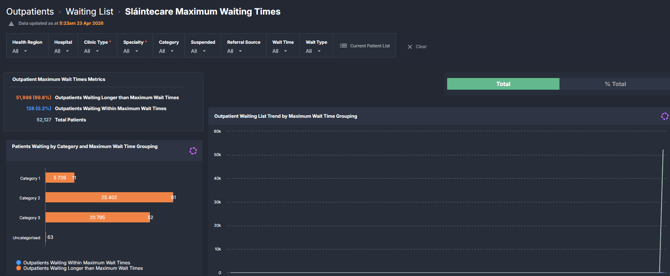
The Sláintecare Maximum Waiting Times component shows the current outpatient waiting list in the context of Sláintecare maximum wait time targets. It highlights how many patients are waiting within and beyond these targets, and how this varies by category, specialty, and booking status.
This component supports analysis of demand, backlog, and waiting list performance across outpatient services.
---
### **Why it matters**
*Understand where outpatient wait times exceed national targets and where pressure is building.*
This component provides visibility of long waits and emerging backlog risk across specialties and categories.
- Identify how many patients are waiting longer than Sláintecare targets
- Monitor growth and changes in the waiting list over time
- Highlight specialties or services contributing most to long waits
- Support planning and prioritisation of outpatient activity
---
### **How to use it**
#### **Filter to focus your view**
Use the filter bar to refine the waiting list population:
- **Health Region**: Select a region or view all regions
- **Hospital**: Focus on a specific hospital
- **Clinic Type**: Include reportable or non-reportable clinics
- **Specialty**: Analyse a specific outpatient specialty
- **Category**: Filter by triage urgency (for example, Category 1, 2, 3)
- **Suspended**: Include or exclude patients not ready for care
- **Referral Source**: Filter by referral origin (for example, GP or internal)
- **Wait Time**: Define how long patients have been waiting (default may vary locally)
- **Wait Type**: Filter by wait classification
Use the **Current Patient List** button to view and [🔗export](https://academy.healthcarelogic.com/knowledge/how-do-i-export-charts-and-tables)patient-level data for the selected filters.
### **Monitor waiting list performance against targets**
| Tile / Chart Name | What it shows |
| --- | --- |
| **Outpatient Maximum Wait Times Metrics** | Summary of total patients, including counts waiting within and longer than maximum wait times |
| **Outpatient Waiting List Trend by Maximum Wait Time Grouping** | Trend over time showing total referrals and proportion exceeding maximum wait times |
| **Patients Waiting by Category and Maximum Wait Time Grouping** | Breakdown of patients by triage category and whether they are within or beyond targets |
| **Outpatients Waiting Longer Than Maximum Wait Times by Specialty and Booking Status** | Patients exceeding targets by specialty, split into booked and unbooked cohorts |
| **Outpatients Waiting Within Maximum Wait Times by Specialty and Booking Status** | Patients within targets by specialty, split into booked and unbooked cohorts |
---
### **How it works**
SystemView uses outpatient referral and waiting list data from the source system to calculate how long each patient has been waiting. This is compared against Sláintecare maximum wait time targets to classify patients as either within or beyond target.
The component updates daily and reflects the most recent available waiting list data.
Patients marked as **Suspended** are those not currently ready for care due to clinical or personal reasons, depending on how this is recorded in the source system.
---
### **How it helps you**
- **Identify long waits quickly**: See how many patients are exceeding maximum wait time targets
- **Focus on high-pressure areas**: Highlight specialties and categories driving backlog
- **Support booking decisions**: Distinguish between booked and unbooked long-wait patients
- **Track performance over time**: Monitor whether waiting list pressure is increasing or improving
- **Enable detailed follow-up**: Export patient-level data for targeted action
---
### **Best practices**
### **How often should I use it?**
| What to do | How often | Who typically does this | Why it helps |
| --- | --- | --- | --- |
| Review overall long wait volumes | **Daily or weekly** | Waiting List Managers, Scheduled Care Teams | Maintains visibility of backlog and emerging risks |
| Analyse specialty-level long waits | **Weekly** | Service Managers, Consultants | Identifies where demand exceeds capacity |
| Monitor booking status of long-wait patients | **Weekly** | Booking Officers, Administration Teams | Supports prioritisation of unbooked patients |
| Track trends over time | **Monthly** | Executives, Operational Leaders | Informs planning and performance discussions |
### **Pair with these components**
- **🔗** [**Waiting List \> Trends**](https://academy.healthcarelogic.com/knowledge/outpatients-waiting-list-trends-0): Understand how the waiting list is changing over time
- **🔗**[**Waiting List \> Patient List**](https://academy.healthcarelogic.com/knowledge/outpatients-waiting-list-patient-list): Investigate individual patients contributing to long waits
- **🔗** [**Waiting List \> Risks & Projections**:](https://academy.healthcarelogic.com/knowledge/outpatients-waiting-list-risks-and-projections) Identify patients at risk of breaching targets
#### **Tips for success**
- Regularly review both **within** and **beyond target** cohorts to maintain balance between performance and prevention
- Focus on **unbooked long-wait patients** to identify immediate booking opportunities
- Use specialty-level views to support service-level planning and discussions
- Be aware that definitions and targets reflect Sláintecare policy and may evolve over time
- Confirm filter selections before interpreting results, especially when comparing across sites
---
### **FAQs**
**Are timeframes used in Sláintecare and other Waiting list components different?**
- Sláintecare timeframes are not taking the timeframes linked to the priority categories in account
- Outpatient waiting list component without reference to Sláintecare displays data based on the timeframe linked with category Urgent/Semi-Urgent/Routine
**What does “Maximum Wait Time” refer to?**
Maximum wait time refers to Sláintecare outpatient targets, which define the expected maximum time a patient should wait for an appointment.
**Why might the trend appear to drop or change unexpectedly?**
This may reflect changes in source system data, data feed timing, or updates to recorded referrals. If the data appears incorrect, it should be reviewed in the source system or reported for investigation.
---
- [Getting Started](https://academy.healthcarelogic.com/knowledge/getting-started#main-content)
- [Welcome & Introduction](https://academy.healthcarelogic.com/knowledge/getting-started#welcome-introduction)
- [Access & Account Setup](https://academy.healthcarelogic.com/knowledge/getting-started#access-account-setup)
- [Basic Navigation & Layout](https://academy.healthcarelogic.com/knowledge/getting-started#basic-navigation-layout)
- [FAQs & Troubleshooting](https://academy.healthcarelogic.com/knowledge/getting-started#faqs-troubleshooting)
- [Interact](https://academy.healthcarelogic.com/knowledge/interact#main-content)
- [Interact Basics](https://academy.healthcarelogic.com/knowledge/interact#interact-basics)
- [Customising SystemView](https://academy.healthcarelogic.com/knowledge/interact#customising-systemview)
- [Sharing & Duplicating Content](https://academy.healthcarelogic.com/knowledge/interact#sharing-duplicating-content)
- [Using Notifications & Improvement Tools](https://academy.healthcarelogic.com/knowledge/interact#using-notifications-improvement-tools)
- [Surgery](https://academy.healthcarelogic.com/knowledge/surgery#main-content)
- [Introduction & Terminology](https://academy.healthcarelogic.com/knowledge/surgery#introduction-terminology)
- [Waiting List Management](https://academy.healthcarelogic.com/knowledge/surgery#waiting-list-management)
- [Scheduling & Booking Management](https://academy.healthcarelogic.com/knowledge/surgery#scheduling-booking-management)
- [Performance & Activity Analysis](https://academy.healthcarelogic.com/knowledge/surgery#performance-activity-analysis)
- [Emergency Surgery](https://academy.healthcarelogic.com/knowledge/surgery#emergency-surgery)
- [FAQs & Troubleshooting](https://academy.healthcarelogic.com/knowledge/surgery#faqs-troubleshooting)
- [Outpatients](https://academy.healthcarelogic.com/knowledge/outpatients#main-content)
- [Introduction & Terminology](https://academy.healthcarelogic.com/knowledge/outpatients#introduction-terminology)
- [Waiting List Management](https://academy.healthcarelogic.com/knowledge/outpatients#waiting-list-management)
- [Referral Management](https://academy.healthcarelogic.com/knowledge/outpatients#referral-management)
- [Wait Times](https://academy.healthcarelogic.com/knowledge/outpatients#wait-times)
- [Demand & Capacity Planning](https://academy.healthcarelogic.com/knowledge/outpatients#demand-capacity-planning)
- [Bookings & Reviews](https://academy.healthcarelogic.com/knowledge/outpatients#bookings-reviews)
- [Clinic Effectiveness & Appointment Outcomes](https://academy.healthcarelogic.com/knowledge/outpatients#clinic-effectiveness-appointment-outcomes)
- [Virtual Learning & Tools](https://academy.healthcarelogic.com/knowledge/outpatients#virtual-learning-tools)
- [Beds](https://academy.healthcarelogic.com/knowledge/beds#main-content)
- [Introduction & Foundations](https://academy.healthcarelogic.com/knowledge/beds#introduction-foundations)
- [Inpatient Demand & Capacity](https://academy.healthcarelogic.com/knowledge/beds#inpatient-demand-capacity)
- [Complex Patients Management](https://academy.healthcarelogic.com/knowledge/beds#complex-patients-management)
- [Risk of Hospitalisation & Readmissions](https://academy.healthcarelogic.com/knowledge/beds#risk-of-hospitalisation-readmissions)
- [Length of Stay & Inpatient Flow](https://academy.healthcarelogic.com/knowledge/beds#length-of-stay-inpatient-flow)
- [Inpatient Occupancy Forecaster](https://academy.healthcarelogic.com/knowledge/beds#inpatient-occupancy-forecaster)
- [Emergency Department](https://academy.healthcarelogic.com/knowledge/emergency-department#main-content)
- [Introduction & Foundations](https://academy.healthcarelogic.com/knowledge/emergency-department#introduction-foundations)
- [Department Now](https://academy.healthcarelogic.com/knowledge/emergency-department#department-now)
- [Flow Monitor](https://academy.healthcarelogic.com/knowledge/emergency-department#flow-monitor)
- [Performance Trends & Analytics](https://academy.healthcarelogic.com/knowledge/emergency-department#performance-trends-analytics)
- [Virtual Learning & Tools](https://academy.healthcarelogic.com/knowledge/emergency-department#virtual-learning-tools)
- [FAQs & Troubleshooting](https://academy.healthcarelogic.com/knowledge/emergency-department#faqs-troubleshooting)
- [SystemView 2](https://academy.healthcarelogic.com/knowledge/systemview-2)
- [System Administration](https://academy.healthcarelogic.com/knowledge/system-administration)
- [Patient Cohorts](https://academy.healthcarelogic.com/knowledge/patient-cohorts#main-content)
- [Beds](https://academy.healthcarelogic.com/knowledge/patient-cohorts#beds)
- [Emergency Department](https://academy.healthcarelogic.com/knowledge/patient-cohorts#emergency-department)
- [Release Notes](https://academy.healthcarelogic.com/knowledge/release-notes)
[](https://healthcarelogic.com/)
[mailto:customersuccess@healthcarelogic.com](mailto:customersuccess@healthcarelogic.com)
© 2026 HealthCare Logic. All rights reserved
**Didn't find what you were looking for?**
[Raise a support ticket](https://academy.healthcarelogic.com/knowledge/kb-tickets/new) and our team will come back to you. For guided training try the [Learning Hub](https://academy.healthcarelogic.com/learning-hub), or catch up on a [past webinar](https://academy.healthcarelogic.com/learning-hub/webinars).