---
title: Wait Times > Time Seen
description: View and analyse how long outpatients waited to be seen using treated waiting time distributions, with comparisons across specialties, doctors, and clinics to identify variation and outliers.
---
[Skip to content](https://academy.healthcarelogic.com/knowledge/outpatients-wait-times-time-seen#main-content)
[Contact Us](https://academy.healthcarelogic.com/knowledge/kb-tickets/new)
[](https://academy.healthcarelogic.com/knowledge)
- [Getting Started](https://academy.healthcarelogic.com/getting-started-with-systemview)
- [Domain Overviews](https://academy.healthcarelogic.com/learning-hub/domain-overviews)
- [On-demand Learning](https://academy.healthcarelogic.com/learning-hub/webinars/australia/on-demand-webinars)
- [Webinars](https://academy.healthcarelogic.com/learning-hub/webinars)
Open main navigation
Close main navigation
- [Getting Started](https://academy.healthcarelogic.com/getting-started-with-systemview)
- [Domain Overviews](https://academy.healthcarelogic.com/learning-hub/domain-overviews)
- [On-demand Learning](https://academy.healthcarelogic.com/learning-hub/webinars/australia/on-demand-webinars)
- [Webinars](https://academy.healthcarelogic.com/learning-hub/webinars)
- [Contact Us](https://academy.healthcarelogic.com/knowledge/kb-tickets/new)
- [Contact Us](https://info.healthcarelogic.com/contact-us)
[Contact Us](https://info.healthcarelogic.com/contact-us)
Search the Knowledge Base
- There are no suggestions because the search field is empty.
1. [SystemView Knowledge Base](https://academy.healthcarelogic.com/knowledge)
2. [Outpatients](https://academy.healthcarelogic.com/knowledge/outpatients)
3. [Wait Times](https://academy.healthcarelogic.com/knowledge/outpatients#wait-times)
April 24, 2026
# Wait Times \> Time Seen
## Understand how long patients waited to be seen and identify variation across specialties, doctors, and clinics.
#### **Location in SystemView:** Explore **\>** Outpatients \> Wait Times \> Time Seen
**In this article:**
- [What it is](https://academy.healthcarelogic.com/knowledge/outpatients-wait-times-time-seen#what-it-is)
- [Why it matters](https://academy.healthcarelogic.com/knowledge/outpatients-wait-times-time-seen#Why-it-matters)
- [How to use it](https://academy.healthcarelogic.com/knowledge/outpatients-wait-times-time-seen#How-to-use-it)
- [How it works](https://academy.healthcarelogic.com/knowledge/outpatients-wait-times-time-seen#How-it-works)
- [How it helps you](https://academy.healthcarelogic.com/knowledge/outpatients-wait-times-time-seen#How-it-helps)
- [Best practices](https://academy.healthcarelogic.com/knowledge/outpatients-wait-times-time-seen#Best-practices)
---
### **What it is**
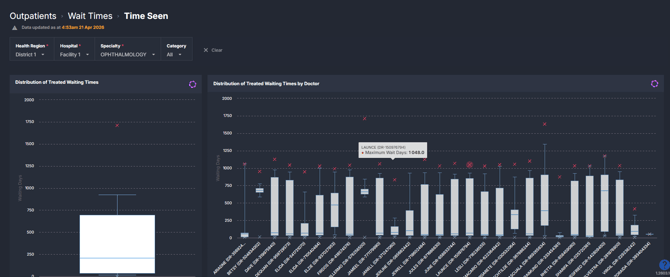
The **Time Seen** component shows the distribution of waiting times for patients who have already been seen and removed from the outpatient waiting list. It focuses on completed care, allowing analysis of how long patients actually waited for their appointment.
It provides comparisons across specialties, doctors, and clinics using distribution-based visualisations such as box and whisker charts.
---
### **Why it matters**
##### *Understand actual patient wait times and variation in delivered care.*
This component provides a retrospective view of waiting time performance, helping teams assess how long patients waited before being seen.
- **Compare** wait time variation within the same specialty
- **Identify** differences between doctors or clinics
- **Highlight** long waits and outliers in completed care
- **Support** review of booking and scheduling practices
---
### **How to use it**
#### **Filter to focus your view**
Use the filter bar to refine the data displayed:
- **District**: Select the relevant region
- **Facility**: Focus on a specific facility
- **Specialty**: Analyse a specific outpatient specialty
- **Category**: Filter by referral urgency category (for example, Urgent, Semi-Urgent, Routine)
#### **Explore treated waiting time distributions**
| Tile / Chart Name | What it shows |
| --- | --- |
| **Distribution of Treated Waiting Times** | Shows the distribution of wait times (in days) for all patients who have been seen and removed from the waiting list. Includes minimum, maximum, and percentile breakdowns to understand overall spread of wait times. |
| **Distribution of Treated Waiting Times by Doctor** | Breaks down treated waiting times by doctor within the selected specialty. Enables comparison of wait time variation across clinicians and highlights differences in patient experience. |
| **Distribution of Treated Waiting Times by Clinic** | Displays treated waiting time distribution by clinic, supporting comparison across clinic settings and service models. |
| **Distribution of Treated Waiting Times by Wait Days (drill-down)** | When a doctor is selected, shows a detailed breakdown of patients seen over time grouped by wait days, including a trendline for the overall specialty. |
| **Prior Two Year Patient List (drill-down)** | Displays patient-level detail for selected wait day ranges, including appointment date, wait days, and referral category. |
---
### **How it works**
The component uses historical outpatient data for patients who have attended and completed their appointment (that is, patients who have been seen and removed from the waiting list).
**Waiting time** is measured in **wait days**, which represents the number of days a patient waited to be seen, excluding any periods where they were not ready for care.
Data is presented using box and whisker charts to summarise distributions:
- Median (typical wait time)
- Middle 50 percent of patients
- Range of most patients
- Minimum and maximum wait times
This allows users to quickly assess both typical performance and variation.
*How to interpret the charts*
- *Start with the **median** to understand the typical wait time*
- *Use the **box** to assess where most patients sit*
- *Review the **whiskers** to understand the broader range*
- *Check **maximum values** to identify extreme long waits*
*Box and whisker charts are designed to highlight variation, not just averages.*
👉 To learn more about interpreting box and whisker charts in SystemView see: 🔗 [How to interpret Box and Whisker charts? ›](https://academy.healthcarelogic.com/knowledge/how-to-interpret-the-box-and-whisker-charts)
---
### **How it helps you**
- **Assess actual performance**: Review how long patients waited based on completed appointments
- **Identify variation**: Compare differences across doctors, clinics, and specialties
- **Highlight outliers**: Detect unusually long or short waits that may require review
- **Support service improvement**: Inform scheduling, capacity planning, and waitlist management discussions
- **Understand patient experience**: Use real wait time outcomes to guide improvement efforts
---
### **Best practices**
#### **How often should I use it?**
| What to do | How often | Who it’s for | Why it helps |
| --- | --- | --- | --- |
| Review overall treated waiting time performance by specialty | **Weekly or monthly** | Service managers, performance teams | Provides a clear view of actual wait times experienced by patients |
| Compare variation between doctors within a specialty | **Monthly or as needed** | Clinical leads, service managers | Identifies variation in wait times that may require further investigation |
| Review clinic-level differences in waiting times | **Monthly** | Operational teams, clinic coordinators | Highlights differences in scheduling, capacity, or demand across clinics |
| Investigate long waits and outliers | **As needed** | Performance teams, service managers | Supports identification of patients or cohorts with extended waits |
#### **Pair with these components**
- **[🔗 Waiting List \> Patient List](https://academy.healthcarelogic.com/knowledge/outpatients-waiting-list-patient-list)**
To understand the current demand and patients still waiting alongside historical performance
- **🔗 [Wait Times \> Current Waiting List](https://academy.healthcarelogic.com/knowledge/outpatients-wait-times-current-waiting-list)**
Compare patients still waiting with those already seen to understand how current wait times are tracking against completed care.
- **[🔗 Waiting list \> Risk & Projections](https://academy.healthcarelogic.com/knowledge/outpatients-waiting-list-risks-and-projections)**
To assess future risk of long waits based on current demand and capacity
#### **Tips for success**
- Use the **median and interquartile range** to understand typical performance, not just extremes
- Focus on **variation within the same specialty** before comparing across specialties
- Investigate **outliers (long waits)** to understand contributing factors
- Be aware that differences between doctors or clinics may reflect **case mix or service design**, not just performance
- Use this component alongside forward-looking views to avoid relying only on retrospective data
- This is a **retrospective view** and only includes patients who have already been seen
- Differences between doctors or clinics may reflect **case mix, demand, or scheduling practices**, not just performance
- Data reflects the source system and does not adjust or override recorded waiting time
---
**Other useful resources:**
- [How to interpret Box and Whisker charts? ›](https://academy.healthcarelogic.com/knowledge/how-to-interpret-the-box-and-whisker-charts)
- [Getting Started](https://academy.healthcarelogic.com/knowledge/getting-started#main-content)
- [Welcome & Introduction](https://academy.healthcarelogic.com/knowledge/getting-started#welcome-introduction)
- [Access & Account Setup](https://academy.healthcarelogic.com/knowledge/getting-started#access-account-setup)
- [Basic Navigation & Layout](https://academy.healthcarelogic.com/knowledge/getting-started#basic-navigation-layout)
- [FAQs & Troubleshooting](https://academy.healthcarelogic.com/knowledge/getting-started#faqs-troubleshooting)
- [Interact](https://academy.healthcarelogic.com/knowledge/interact#main-content)
- [Interact Basics](https://academy.healthcarelogic.com/knowledge/interact#interact-basics)
- [Customising SystemView](https://academy.healthcarelogic.com/knowledge/interact#customising-systemview)
- [Sharing & Duplicating Content](https://academy.healthcarelogic.com/knowledge/interact#sharing-duplicating-content)
- [Using Notifications & Improvement Tools](https://academy.healthcarelogic.com/knowledge/interact#using-notifications-improvement-tools)
- [Surgery](https://academy.healthcarelogic.com/knowledge/surgery#main-content)
- [Introduction & Terminology](https://academy.healthcarelogic.com/knowledge/surgery#introduction-terminology)
- [Waiting List Management](https://academy.healthcarelogic.com/knowledge/surgery#waiting-list-management)
- [Scheduling & Booking Management](https://academy.healthcarelogic.com/knowledge/surgery#scheduling-booking-management)
- [Performance & Activity Analysis](https://academy.healthcarelogic.com/knowledge/surgery#performance-activity-analysis)
- [Emergency Surgery](https://academy.healthcarelogic.com/knowledge/surgery#emergency-surgery)
- [FAQs & Troubleshooting](https://academy.healthcarelogic.com/knowledge/surgery#faqs-troubleshooting)
- [Outpatients](https://academy.healthcarelogic.com/knowledge/outpatients#main-content)
- [Introduction & Terminology](https://academy.healthcarelogic.com/knowledge/outpatients#introduction-terminology)
- [Waiting List Management](https://academy.healthcarelogic.com/knowledge/outpatients#waiting-list-management)
- [Referral Management](https://academy.healthcarelogic.com/knowledge/outpatients#referral-management)
- [Wait Times](https://academy.healthcarelogic.com/knowledge/outpatients#wait-times)
- [Demand & Capacity Planning](https://academy.healthcarelogic.com/knowledge/outpatients#demand-capacity-planning)
- [Bookings & Reviews](https://academy.healthcarelogic.com/knowledge/outpatients#bookings-reviews)
- [Clinic Effectiveness & Appointment Outcomes](https://academy.healthcarelogic.com/knowledge/outpatients#clinic-effectiveness-appointment-outcomes)
- [Virtual Learning & Tools](https://academy.healthcarelogic.com/knowledge/outpatients#virtual-learning-tools)
- [Beds](https://academy.healthcarelogic.com/knowledge/beds#main-content)
- [Introduction & Foundations](https://academy.healthcarelogic.com/knowledge/beds#introduction-foundations)
- [Inpatient Demand & Capacity](https://academy.healthcarelogic.com/knowledge/beds#inpatient-demand-capacity)
- [Complex Patients Management](https://academy.healthcarelogic.com/knowledge/beds#complex-patients-management)
- [Risk of Hospitalisation & Readmissions](https://academy.healthcarelogic.com/knowledge/beds#risk-of-hospitalisation-readmissions)
- [Length of Stay & Inpatient Flow](https://academy.healthcarelogic.com/knowledge/beds#length-of-stay-inpatient-flow)
- [Inpatient Occupancy Forecaster](https://academy.healthcarelogic.com/knowledge/beds#inpatient-occupancy-forecaster)
- [Emergency Department](https://academy.healthcarelogic.com/knowledge/emergency-department#main-content)
- [Introduction & Foundations](https://academy.healthcarelogic.com/knowledge/emergency-department#introduction-foundations)
- [Department Now](https://academy.healthcarelogic.com/knowledge/emergency-department#department-now)
- [Flow Monitor](https://academy.healthcarelogic.com/knowledge/emergency-department#flow-monitor)
- [Performance Trends & Analytics](https://academy.healthcarelogic.com/knowledge/emergency-department#performance-trends-analytics)
- [Virtual Learning & Tools](https://academy.healthcarelogic.com/knowledge/emergency-department#virtual-learning-tools)
- [FAQs & Troubleshooting](https://academy.healthcarelogic.com/knowledge/emergency-department#faqs-troubleshooting)
- [SystemView 2](https://academy.healthcarelogic.com/knowledge/systemview-2)
- [System Administration](https://academy.healthcarelogic.com/knowledge/system-administration)
- [Patient Cohorts](https://academy.healthcarelogic.com/knowledge/patient-cohorts#main-content)
- [Beds](https://academy.healthcarelogic.com/knowledge/patient-cohorts#beds)
- [Emergency Department](https://academy.healthcarelogic.com/knowledge/patient-cohorts#emergency-department)
- [Release Notes](https://academy.healthcarelogic.com/knowledge/release-notes)
[](https://healthcarelogic.com/)
[mailto:customersuccess@healthcarelogic.com](mailto:customersuccess@healthcarelogic.com)
© 2026 HealthCare Logic. All rights reserved
**Didn't find what you were looking for?**
[Raise a support ticket](https://academy.healthcarelogic.com/knowledge/kb-tickets/new) and our team will come back to you. For guided training try the [Learning Hub](https://academy.healthcarelogic.com/learning-hub), or catch up on a [past webinar](https://academy.healthcarelogic.com/learning-hub/webinars).